Celebrating Chinese New Year and Chinese Music in the Elementary Music Classroom

The Chinese culture has so many amazing aspects that are worth discovering and exploring in music class. Chinese New Year occurs at a different date each year, usually around the end of January. I think that is a great time to learn about this holiday and then explore the music of China.
The elementary school I teach at is a very small school in rural Illinois. There is not a lot of diversity in this area, so I am always looking for new ways to expose the students to different types of people, cultures, and music with the hope of developing a better understanding and respect for others who look and act differently than the people around them.
Here are some activites I plan on doing with my students this year to celebrate Chinese Music and Chinese New Year. Most of my students have never heard of this holiday. I plan to continue doing this unit every year, adding more activites each time for different grade levels, so students can have multiple encounters with the music.
If you are interested in a pre-made slideshow of these resources, I have one you can purchase on Teachers Pay Teachers: Music of China Virtual Field Trip. Most of the videos included in this post are linked in that slideshow.
Introduction to Chinese New Year
There are some great story books that will help me intorduce the holiday to my students. Here are some YouTube read-alouds that I will be using. They give a nice overview of what the holiday is about.
Eyes that Kiss in the Corners by Joanna Ho
I found this book, Eyes that Kiss in the Corners, by Joanna Ho, a while ago and thought it was absolutely wonderful! I love how the author describes the differences in eyes in such a positive way. The story is told from the perspective of a girl with Asian facial features. “Some people have eyes like sapphire lagoons.” “I have eyes that kiss in the corners and glow like warm tea.” I will use this book as an opener to respectfully talk about differences in facial features and appearance.
Throughout the book, there are many different comparisons between the little girl’s eyes, her friend’s eyes, and they eyes of her relatives. At the end of the book, some of those lines are put together into a poem, of sorts. I used those words to create a tune on a pentatonic scale, and sing the song every few pages while reading the book.
Listening and Coloring with Chinese Music
I love giving students time in music class to just be still and listen to music. A lot of students have a hard time just listening, so coloring is a great way to keep hands busy so the brain can listen. I allow no talking during “super quiet listening to music time”. I found some different coloring pages on Teachers Pay Teachers. I have a few different ones so each grade level can have their own activity, and I can keep using it year after year.
2nd graders are filling out this Chinese New Year Booklet: Chinese New Year Cut and Color.
3rd and 4th graders are coloring a few pages from this Chinese New Year Music Symbol Coloring Page. This set has some blank pages included, so the 1st graders are going to color a dragon however they would like while listening.
As for the music we will be listening to, I have a great playlist I found on YouTube. It’s three hours long and has a really nice variety of authentic Chinese classical music. My classes are 30 minutes each, so each group will get to hear a small section of the music, but that seems to be just about the right amount of time.
This video has pop songs from China. I have listened to about 35 minutes of it, and so far everything has been in Chinese. I’m great with that, because I want my students to hear the other language and get a feel for what it sounds like. I also don’t have to worry about swear words if it’s in Chinese.
This song is absolutely beautiful. I love a cappella music in general…and the harmonies in this short song are wonderful.
Rhythm Play-Alongs
My students love rhythm play-along videos. Here are two levels of the same song.
Chinese Ribbon Dance
Another aspect of Chinese music is the ribbon dance. I enjoy including dance in my music classes. Moving musically to music and appreciating beautiful movements to music is an important part of being musical. I found this website with some background about ribbon dance: Chinese Ribbon Dance History. This other website gives some background from the perspective of a professional Chinese Ribbon Dancer. There are three videos on this page that have beautiful ribbon dances and are great examples of the artform: Ribbon Dance of Empowerment.
Here are a few more ribbon dancing examples I will be including:
I have some ribbons in my classroom, so I will be using those to let my students try out some ribbon dance. I found some choreography instructions here: Chinese Ribbon Dance Choreography PDF. The instructions go along with the song Fen Yang Song from World of Music Grade 4, CD 2, track 9.
Mallet Madness has a Chinese Ribbon Dance Activity also. There are so many great resources in that book!
Singing and Playing Chinese Music
I have a few resources I purchased from Teachers Pay Teachers that I will be using to give the students an opportunity to sing and play Chinese Music. They are both very simple songs with Orff arrangements that will be a great experience for my students: Ai Hai Yo, and Song of the Dragon.
Tikki Tikki Tembo by Arlene Mosel
I have been singing and playing this song/book with students for over 20 years! One of my college professors introduced the book to us in class, and I fell in love with it! The main character’s name is rediculously long, which causes a big proglem when he falls into a well. I have turned the character’s name into a short song, with instrument accompaniment. I usually sing and read the book to the students, then on a different day have the students play instruments to accompany the song.
I have my version of Tikki Tikki Tembo available on Teachers Pay Teachers here: Tikki Tikki Tembo. It’s not hard to make up a song for his name, using a pentatonic scale and some simple accompaniments. I set the instruments up in a circle around the room. The students play an instrument and sing when the main character’s name is used in the book. I also have sound effects for the story too. Each instrument part is printed on a card so students remember the parts for each instrument. Students rotate every time we sing/play the name, so they have played multiple instruments by the time the story is done.
Here’s a sample of a class playing the song:
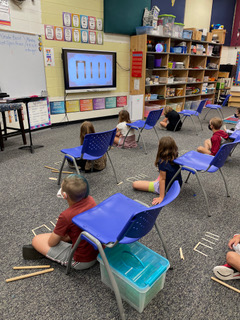
Here’s how I often set up my instrument rotation:


I hope you enjoy exploring Chinese music with your students! Gung hay fat choy!
 Making Music Class Fun